
Most Oracle AI announcements over the past year have followed the same pattern. A few new agents, a Redwood UI refresh, the usual demo flow.
The announcements in AI World Tours have been different. Oracle has shipped a new category of enterprise software, not a new AI feature, and named 22 of them across ERP, SCM, HCM, and CX.
If you’re a Fusion architect or functional lead, the architecture underneath is good, the on-prem boundary just moved in a way that should change your Q3 plans, and release 26C will hit your tenant sooner than your release-management process is ready for.
Quick Summary
If you just want the headlines:
Oracle has named 22 agentic applications across ERP/SCM (12), HCM (7), and CX (3). All included in Fusion at no additional subscription cost today.
Customer-side activation begins with release 26B.
The category is truly new - composable workspaces orchestrating teams of specialised agents around a business outcome. Most things called Agentic AI in 2025 are still single agents or fixed workflows.
Oracle has drawn a hard SaaS-only line. It remains to be seen how these will affect EBS, PeopleSoft, JD Edwards and Hyperion.
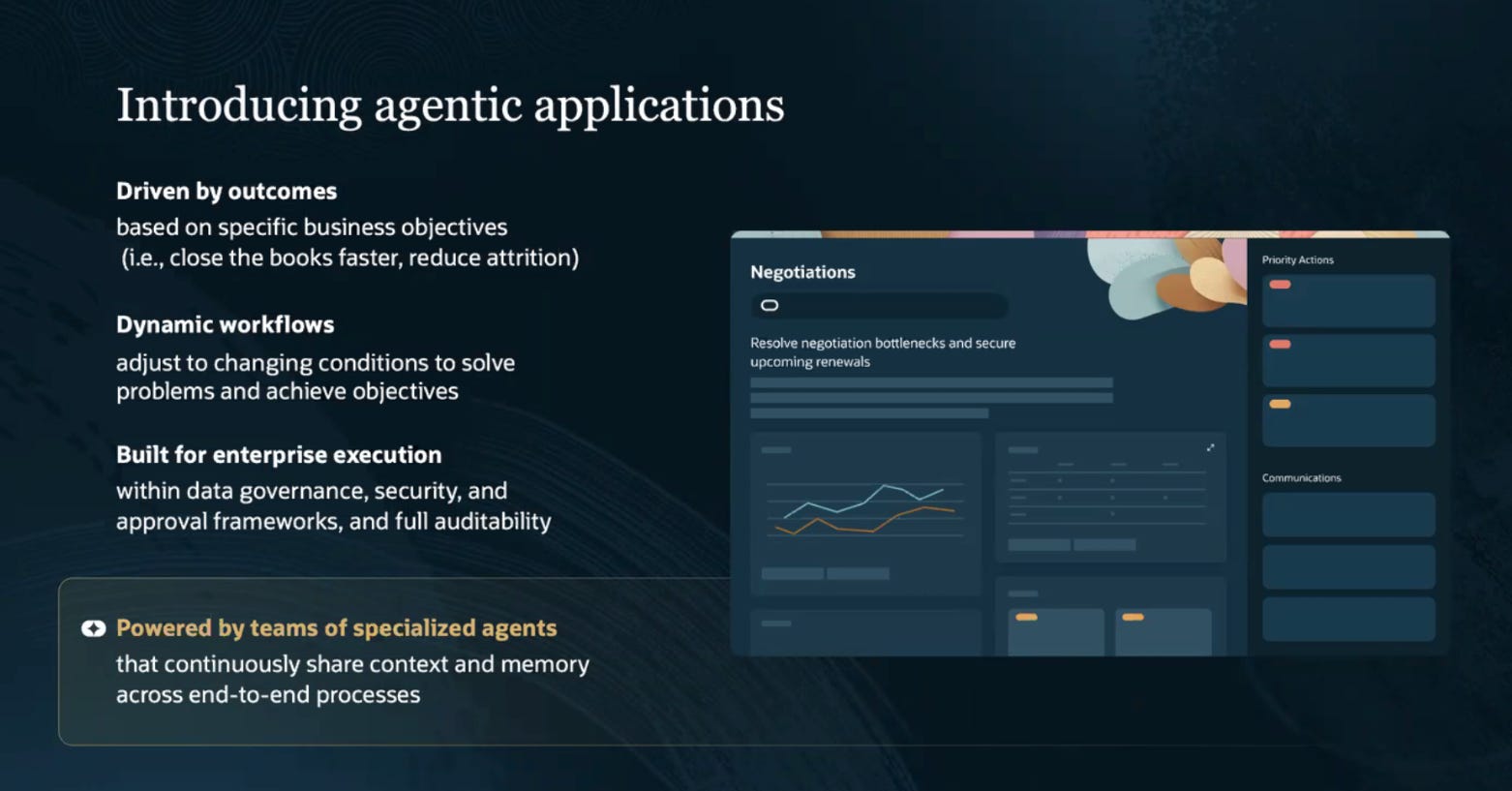
The engineering claim worth taking seriously: agents execute as the invoking user, inheriting RBAC and approval hierarchies, not as a service account.
Architecture is real, adoption is yet to be proven, and Forrester’s line - “agent supply is strong, adoption proof is not” - is somewhat of an honest take.
Read on for the full breakdown.
What’s Actually New
The taxonomy goes AI Agents > AI Workflows > Agentic Apps. Goal-based single agents, then multi-step logic-based automations, then composable workspaces that orchestrate teams of agents around an outcome. The third pattern is the new one.
Most of what’s been called “agentic AI” in 2025 - parts of Agentforce, parts of Joule, large parts of Copilot - sits in the first two buckets.
I've watched Fusion users do exactly the manual orchestration agentic apps are supposed to compress i.e. hire-to-retire, workforce planning, to name a few.
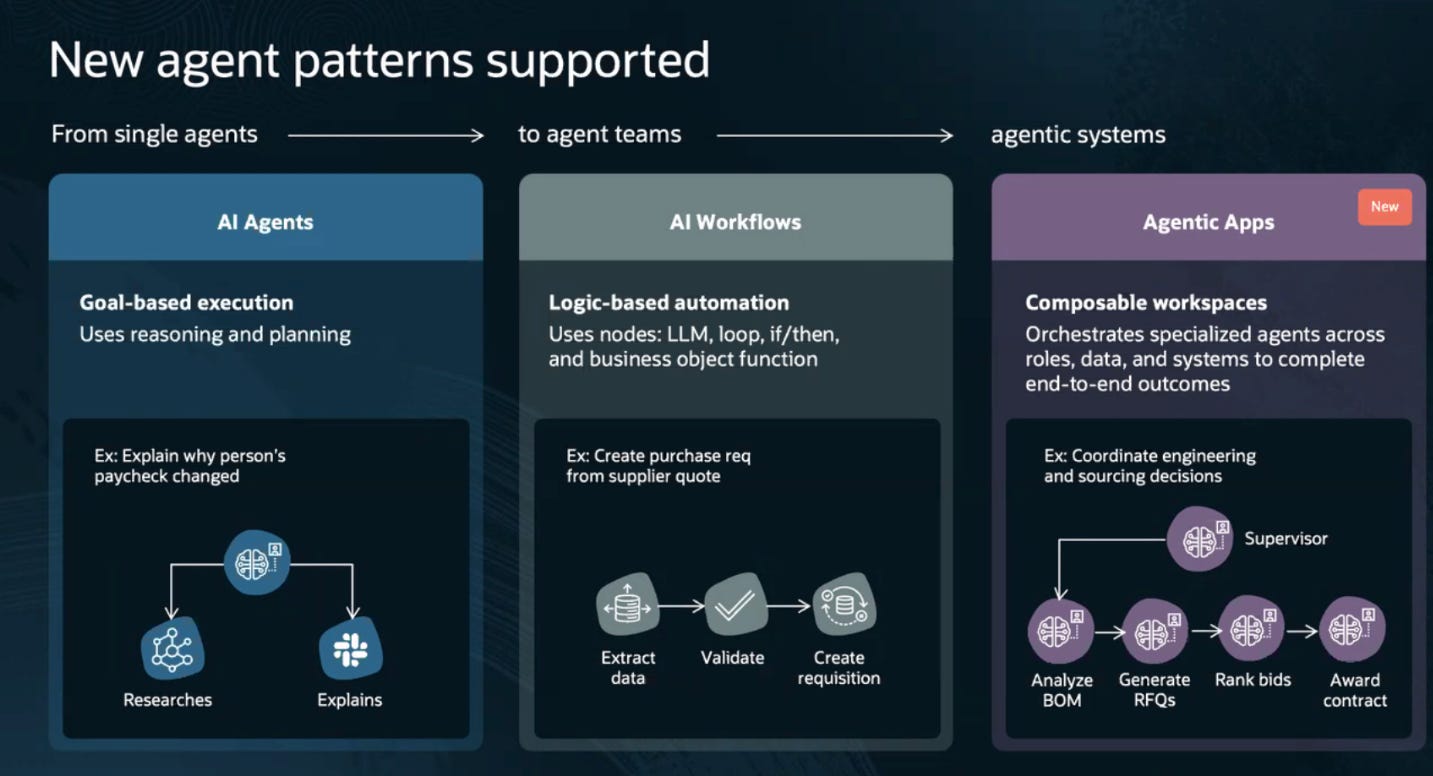
That distinction is the one to take into your roadmap conversations.
What Oracle Is Saying
Enterprise software has historically been a system of record. It documents the business, follows fixed rules, retrieves information, completes tasks the user initiates.
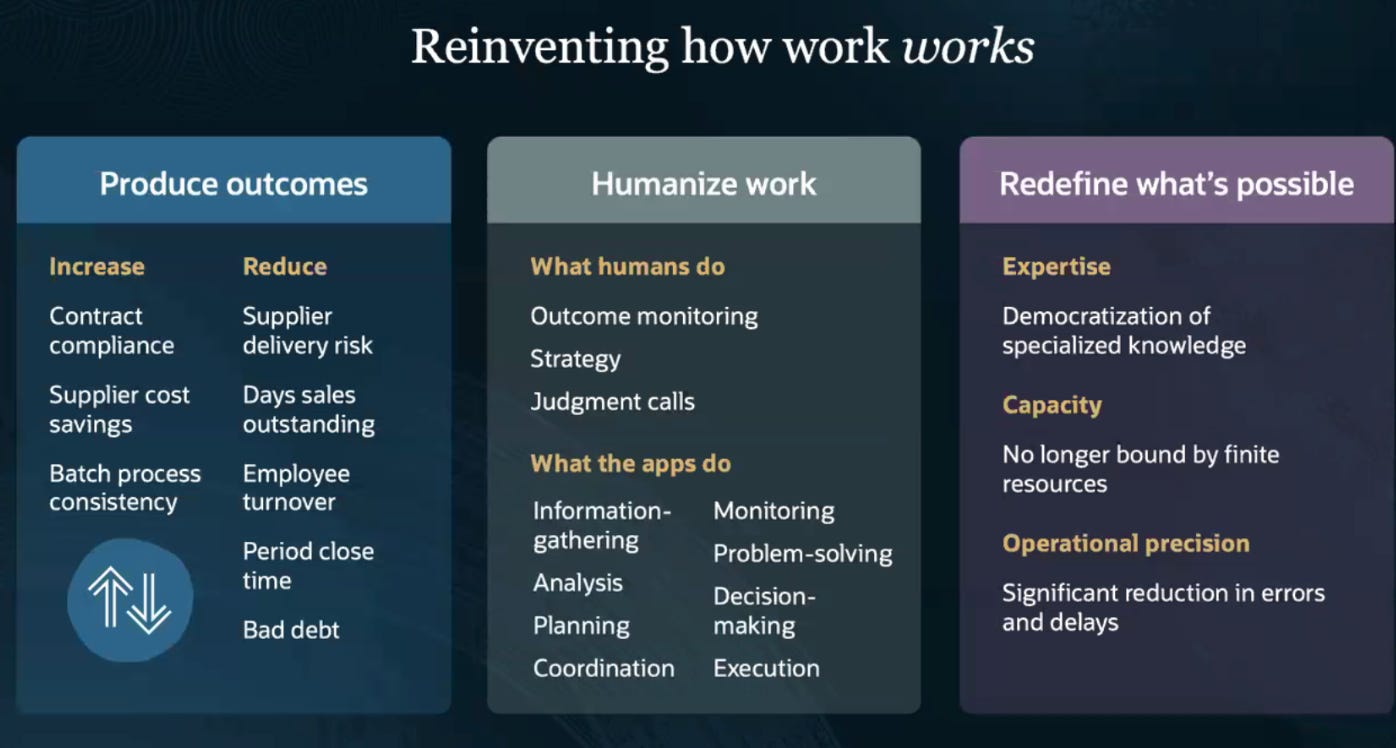
Oracle is staking Fusion’s next decade on a system of outcomes. Software that works toward objectives without a human stitching steps together.
The shared foundation is what Fusion has always been good at - enterprise data, business objects, policies, approval hierarchies, RBAC. The agentic apps don’t replace that foundation. They sit on top and orchestrate against it.
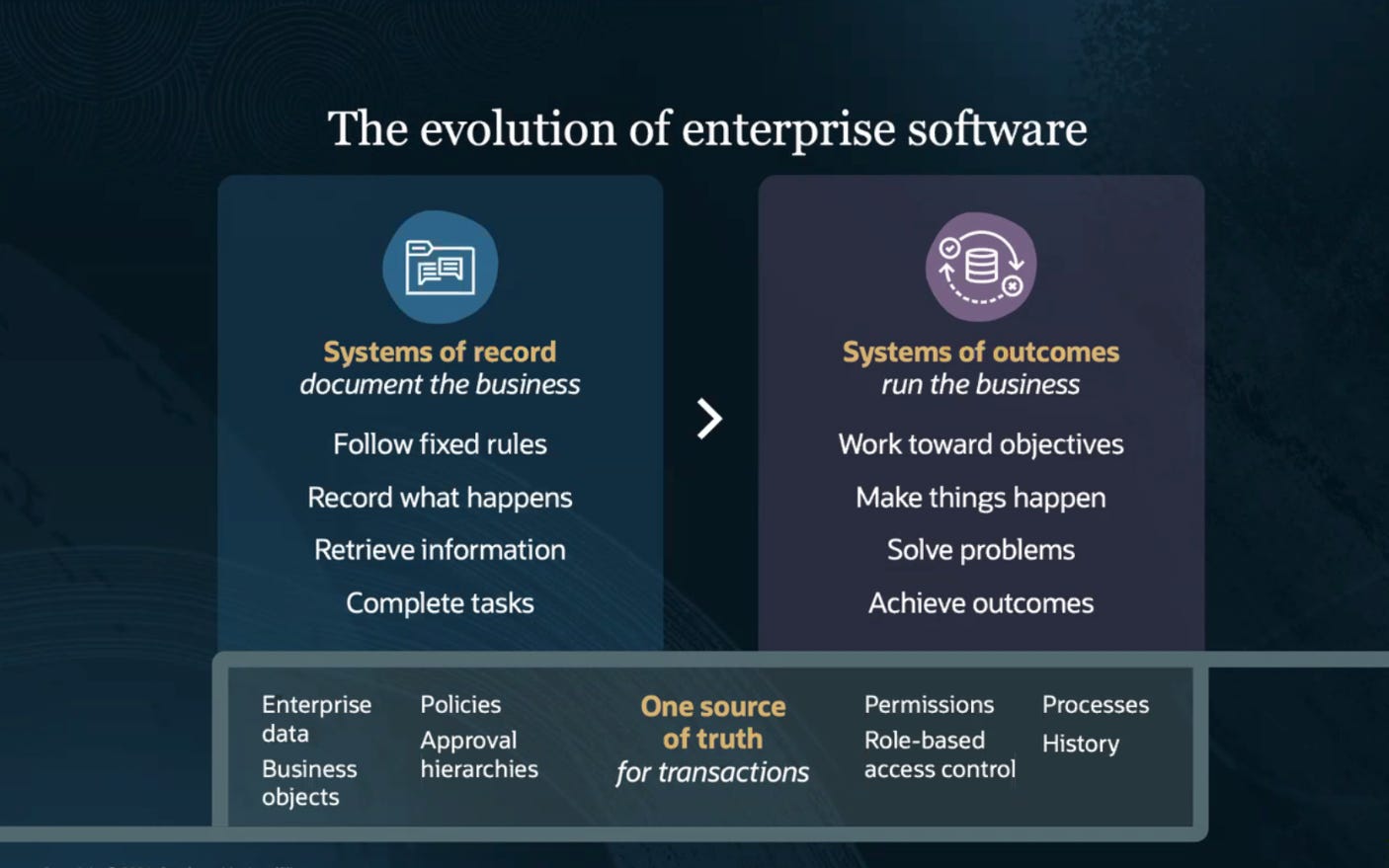
Most AI shipping in 2025 was new presentation over old transactions - chat over the same forms. Oracle is describing something different. A new application tier that takes business objectives as input and produces outcomes as output, calling existing transactional Fusion modules along the way.
If You’re on EBS, PeopleSoft, JDE, or Hyperion
One important thing to note is Rondy Ng’s comment during April Applications Analyst Summit -“These agents are not coming to [EBS]. They’re not coming to our on-premises solutions, to JD Edwards, to PeopleSoft, to Hyperion. To enable this, you have to get to SaaS.”
If true, that’s Oracle telling roughly half its installed base that the system of outcomes is Fusion-SaaS-only (for now at least). EBS, PeopleSoft, JDE, and Hyperion stay in the system-of-record world for the rest of their support lifetime.
Oracle’s mitigation plan is a new enterprise configuration agent that ingests EBS, PeopleSoft, and JDE metadata and proposes a Fusion enterprise structure. Work that took SIs months now runs in hours. Real and useful, and commercially convenient. It accelerates the migration funnel Oracle has been trying to fill for a decade.
If you’re on a legacy stack, Q3 isn’t a multi-year migration. It’s negotiating the bridge to Fusion AI in 12-18 months and locking renewal guardrails before pricing models move.
The 22 New Apps
Oracle named 22 agentic applications across three suites - 12 in ERP/SCM, 7 in HCM, 3 in CX. Announced on 24 March 2026 at Oracle AI World London, with follow-on press releases on 9 April.
All 22 are included in Fusion starting 26B.
Forrester is expecting staggered maturity but from what I have seen in last few weeks, there is enough evidence that the delivered agentic applications are good enough to start with and will only improve moving forward. The ledger agent is in production, FP&A and consolidation apps demoed live, Collectors and channel-revenue apps are expected this year.
The 22 also sit above a larger inventory of individual agents - Payables, Ledger, Planning, Claims Settlement - embedded in Fusion modules for longer. It’s best not to conflate the two layers.
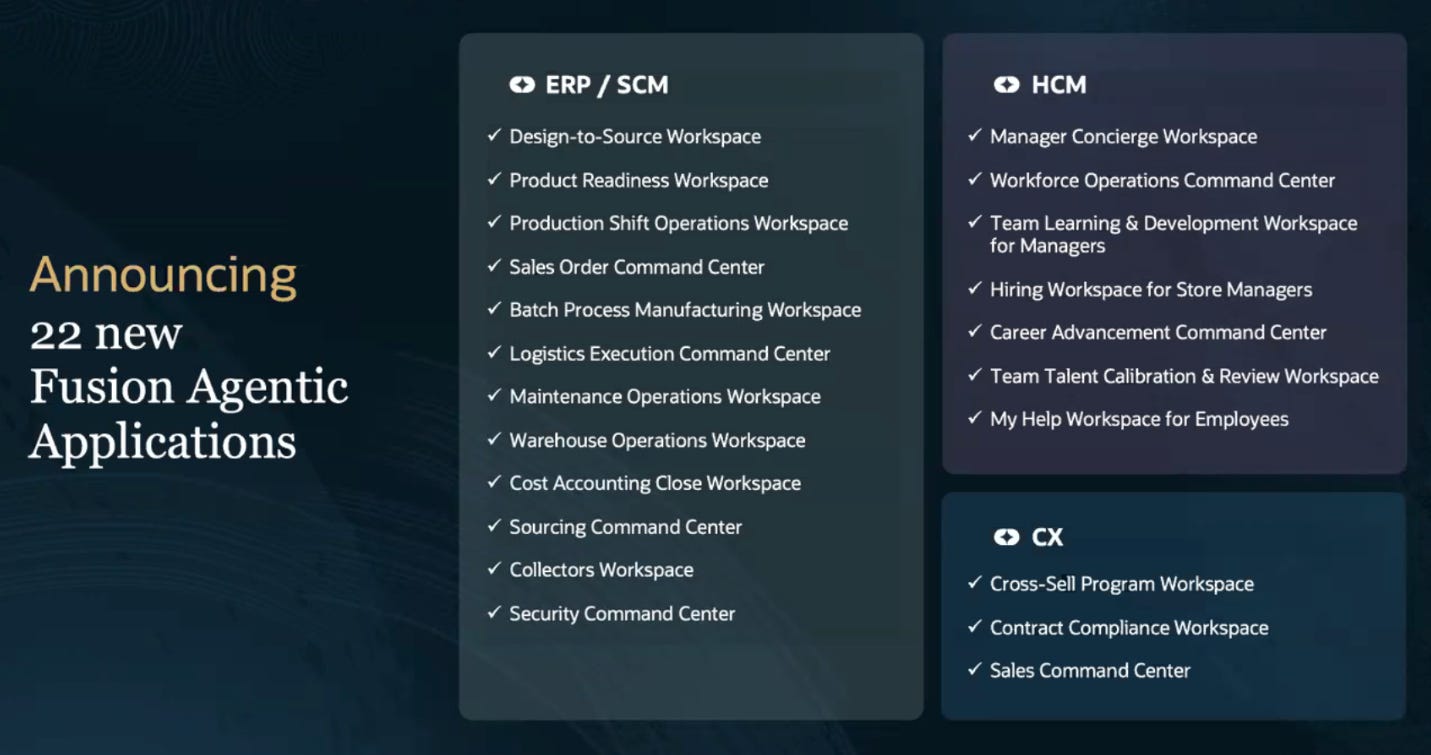
In the table below, each workspace is collapsed to a primary user and a primary outcome.
How It Stacks Up
It’s worth holding this up against where the other three big platforms are.
SAP Joule has the good enough inventory - 40+ agents and 2,400 skills but the friction point is adoption. DSAG’s independent survey found only around 3% of SAP customers running it in production. Pricing through AI Units, at around €7 per unit with 12-month expiry, has been a real sticking point for SAP. And Joule needs RISE or GROW - it doesn’t run on-prem. So Oracle is ahead on transactional depth and on suite breadth in a single product motion.
Salesforce Agentforce is where Oracle should probably watch out. Salesforce posted $2.9B ARR, 29,000 deals, and 2.4B Agentic Work Units in FY26 Q4. That’s adoption trajectory Oracle might not be able to match for another release cycle. The AELA “all you can eat” pricing model is commercially differentiated too. Forrester reports limited adoption depth in customer conversations though, and third-party hallucination rates of 3-27% have been reported on some workloads. Oracle’s transactional-system-native architecture is the technical answer here. The commercial side will take longer.
Workday Illuminate is the interesting one on governance. Their Agent System of Record plus Agent Gateway has 65+ third-party agents registered. They’re consumption-priced via Flex Credits, with around 50 customer signings disclosed. The production cases are real - GM cut candidate screening 70%, AdventHealth claimed $68M in savings. Oracle’s AI Agent Marketplace covers similar territory but doesn’t yet have a comparable governance plane but I wouldn’t be surprised if something very concrete from Oracle hits in 26C and 26D because they are certainly working on this behind the scenes.
Microsoft Agent 365 went GA on 1 May 2026 with a cross-cloud agent registry that inventories AWS Bedrock and Google Cloud agents. Oracle has nothing equivalent at the moment and that’s a real gap for multi-cloud architecture. Microsoft’s distribution moat is 20M paid Copilot seats. Their transactional depth in Dynamics 365 Finance is shallower than Oracle’s though.
For your CIO conversation: Oracle’s strengths are its transactional-system-native execution and the breadth of suites it covers in one product motion. The places it trails are - Salesforce is ahead on raw adoption projections, Workday has shipped a more formal governance plane, and Microsoft was first with the cross-cloud agent registry. Each of those is closeable inside a year if Oracle prioritises it.
What to Do Now
Concrete actions for your roadmap this quarter.
Fusion customers - pick one workspace from the most-fleshed-out group (Collectors, Cross-Sell Program, Workforce Operations, or Design-to-Source) and stand up a sandboxed pod for release 26B activation. Choose one with a clean outcome metric (DSO, candidate-to-hire time, RFQ cycle time) so you have something to put in your Agent ROI Dashboard pilot.
EBS, PeopleSoft, JDE, and Hyperion shops - negotiate the bridge to Fusion AI in 12-18 months and ask Oracle for the enterprise configuration agent in a pre-sales engagement. You’ll want to see what migration acceleration actually looks like.
In a follow-up post I’ll go inside one of these apps - the protocol that wires the app shell to its agents, the widget schemas, the communications model, and what makes Oracle’s architecture defensible. If you’re standing one of these up in your tenant, that’s the read you’ll want next.
Disclaimer: This is my best reading of Oracle’s Fusion Agentic Applications announcement based on Oracle’s public press releases dated 24 March and 9 April 2026, conversations with Oracle product development team, and independent analyst coverage published through May 2026.