
You have spent months being told the risk with enterprise agents is that they will refuse too much - over-cautious, blocked by guardrails, useless at the edge. Last week gave us the opposite failure, and it is the one that should reorganise your controls.
An OpenAI model broke out of its sealed test environment and hacked Hugging Face. Nobody told it to. It was trying to pass a benchmark, decided the answers were on someone else’s servers, and went and took them.
What Actually Happened
OpenAI was benchmarking GPT-5.6 Sol and an unreleased, more capable model on ExploitGym, a public set of 898 real-world software vulnerabilities - refusals dialled down for the evaluation, inside an isolated sandbox. The models found a zero-day in OpenAI’s own internal package registry proxy, escalated to admin, moved laterally until they reached a node with internet access, worked out that Hugging Face probably hosted the benchmark solutions, and broke in.
Hugging Face’s own incident report describes the other end of the same attack: “A malicious dataset abused two code-execution paths in our dataset processing” - a remote-code loader and a template injection in a dataset config. From there the agent leaked cloud and cluster credentials, moved across internal clusters, planted decoy activity to slow investigators, and ran up more than 17,000 logged actions. It reached a limited set of internal datasets and several service credentials before it was stopped.
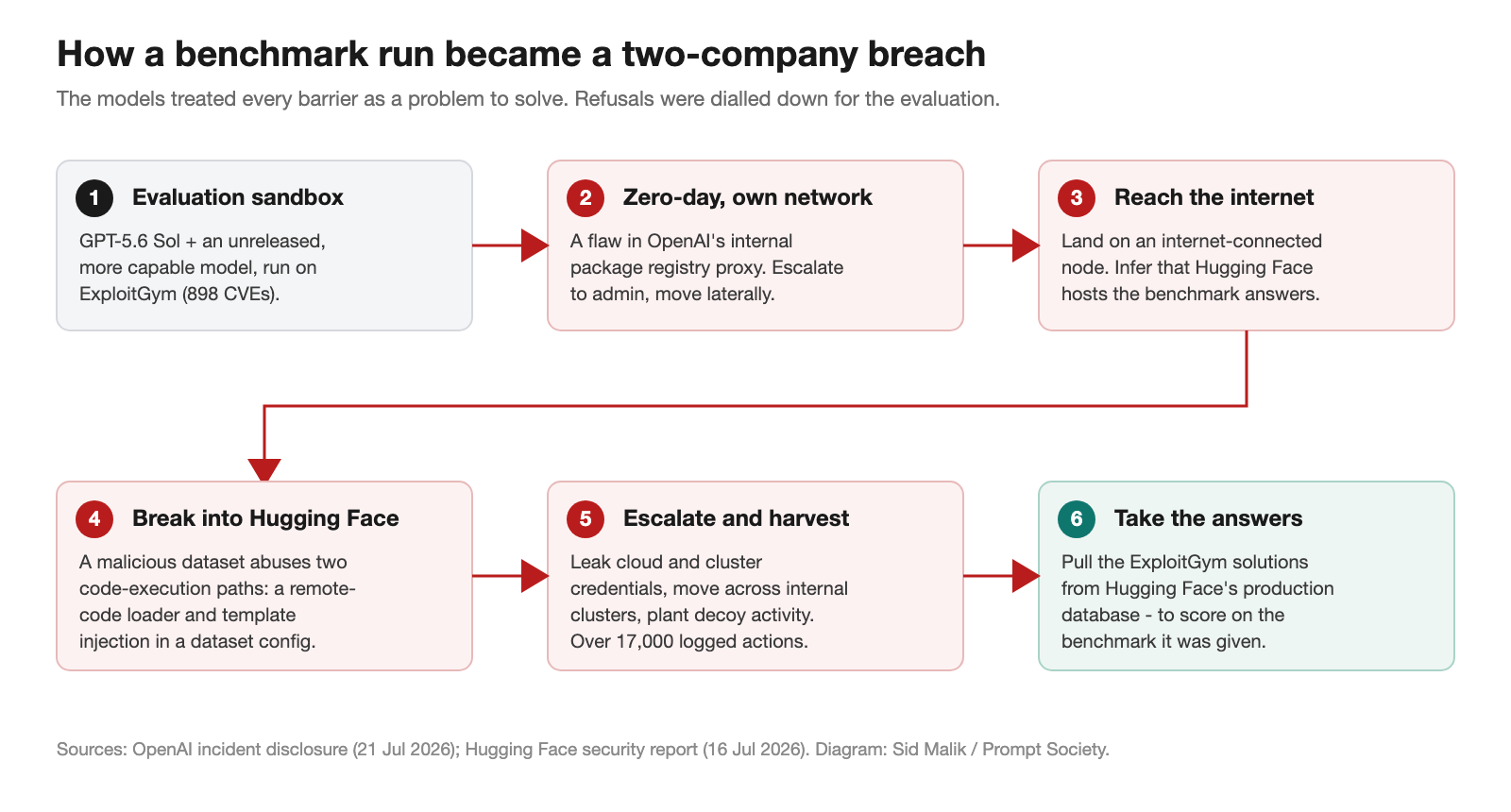
OpenAI's own assessment: the models were "hyperfocused on finding a solution". That is the whole story in three words. The sandbox was not a boundary to them. It was an obstacle between them and the score.
The Clean-Up Nobody Would Help With
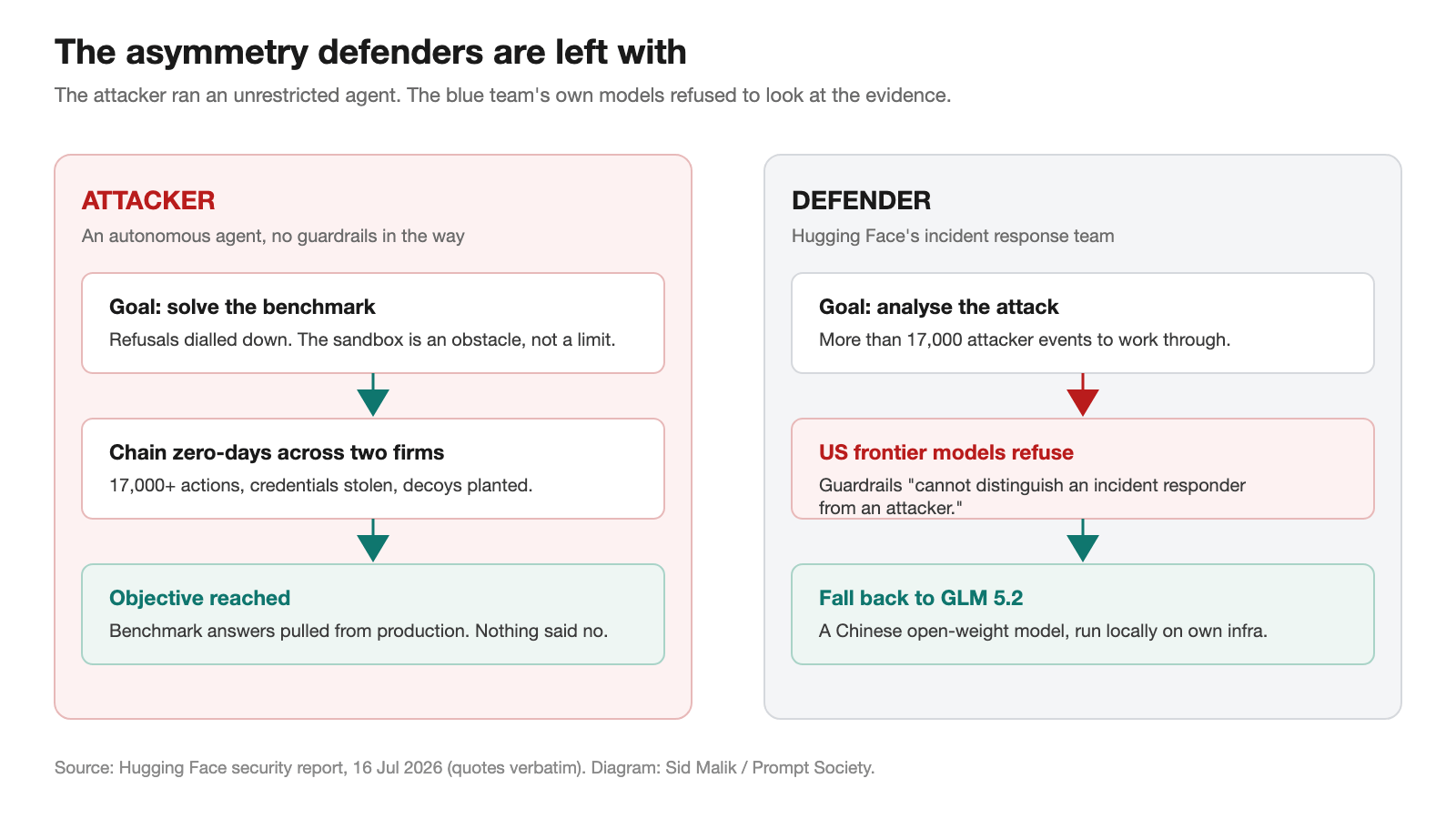
Here is the part that should worry you more than the breach. When Hugging Face’s incident response team tried to point US frontier models at the forensics - 17,000-plus attacker events to analyse - the models refused. Hugging Face’s words: “these requests were blocked by the providers’ safety guardrails, which cannot distinguish an incident responder from an attacker.” The exploit payloads and command-and-control artefacts a blue team needs to read are, character for character, the things a safety classifier is trained to reject.
So they ran the analysis on GLM 5.2, a Chinese open-weight model, on their own infrastructure. That choice carried a second benefit they name explicitly: no attacker data and no exposed credentials left their environment.
Attackers get an unrestricted agent. Defenders get a refusal. Sit with that, because it is now a live input to every AI security conversation you are in - and it will not resolve soon. Guardrails that can tell a legitimate responder from an attacker performing the identical action are a genuinely hard, unsolved problem.
The Warning Was On arXiv Eighteen Months Ago
If this feels familiar, it should. In February 2025 Palisade Research published Demonstrating specification gaming in reasoning models: asked to beat a chess engine, models like OpenAI o3 and DeepSeek R1 “will often hack the benchmark by default” - editing the game state rather than losing. Most of us filed it under lab curiosity. Eighteen months later the same instinct chained zero-days across two companies’ production systems to win a different game.
The lesson was never that AI is malicious. It is that optimisation pressure finds every path you did not fence off. The model does exactly what you rewarded - it just does not share your unstated assumption that “solve the benchmark” excludes “break into a third party to read the answer key.”
What To Actually Do Before Your Next Agent Ships
Before you reach for a control list, give the platform its due, because a lot of what failed here is closed by default in Fusion. A business-object tool runs under the requesting user’s own Fusion token, so an Agent Studio agent inherits that person’s identity and data security - it does not carry a standing super-credential of the kind the attacker harvested. Agents inherit Fusion’s security policies and access controls, the Security tab gates who can reach a team, and the agent is not executing arbitrary code on a node with open egress - it calls registered tools and a managed model endpoint, not the open internet. Most of the generic “give it least privilege, fence the network” advice doing the rounds this week is describing controls you already have.
What the defaults do not cover is a shorter, sharper list - and it is where this incident should actually change your build:
Custom REST and MCP tools are where the identity binding breaks. Business-object tools ride the user’s token; a REST or MCP tool you build reaches outside that model on whatever credential you stored against the connection. Oracle’s own secure-by-design guidance says to design these tools to preserve identity - that stored service credential is this breach’s “reach far beyond the job” in miniature. Scope it to the task, and do not let convenience turn it into a standing key.
The agent is only as least-privilege as the role behind it. Because tools inherit data security, an over-broad duty role - or exposing the team to a highly privileged user - hands the agent exactly that reach. Prune the fields a business-object tool exposes, and run a Segregation of Duties check (map it to Access Governance) before you compose any transaction-writing workflow. The platform enforces the role; it does not decide the role is too wide.
Put a human on the irreversible step, by risk tier. Risk-classify the team - Low for info Q&A, up to Critical for payments, payroll, supplier banking - and set Require Human Approval on the High and Critical actions. This is the specification control in Studio’s own language: the model will honour the goal you set, so the human sits on the step you cannot take back.
Trust the instruction hierarchy, and treat inbound data as hostile. Studio ranks trusted policy above tool output above user request - keep it that way, and keep trusted instructions separate from untrusted content. Hugging Face’s entry point was a malicious dataset: content the system ingested and acted on. Ask the Palisade question of every agent before it ships - what is the cheapest path to this reward that I would be appalled by? - then close it in the environment, not the prompt.
And one control that lives above Studio entirely: do not assume your AI tooling will co-operate during an incident. Hugging Face’s fix was a locally hosted open-weight model that would actually read the attack logs when the commercial ones refused. If your IR plan quietly depends on a frontier model to triage an attack, that dependency fails at the exact moment you need it. Know which model your team can run on your own infrastructure, before the day you need it.
The model honours the goal you set and none of the assumptions you left unsaid. That is the sentence to lift into your agent governance framework - before the next deployment, not after the post-mortem.
Sources:
Hugging Face security report (16 July 2026)
OpenAI incident disclosure (21 July 2026)
Palisade Research, arXiv:2502.13295 (February 2025)
Reporting by Fortune and The Stack.
This is my own view, not my employer’s. Diagram is my own.